
















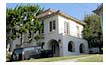

2523 Third St.
Architect: Ellis G. Martin


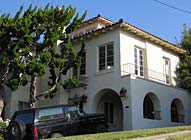
Merle Norman House 1935
Mediterranean Revival style villa
designed by Ellis Martin

Merle Norman
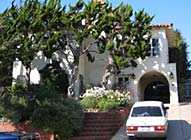
Front view
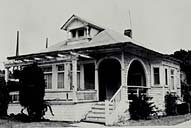
740 Raymond Avenue.
Turn-of-the-century cottage built 1904 by W. H. Slack. moved to Raymond Avenue in 1935
Even before she opened her first studio in Santa
Monica in 1931, Merle Norman's philosophy of "Try Before You Buy"
was being carried out as she offered free samples of her products to neighbors,
hoping they’d discover the benefits and return as paying customers.
And return they did. Many even opened their own studios and the company
now has studios throughout the United States and Canada. Carrying on the
Merle Norman tradition, franchisees now offer skin care products, from
cleansers and toners to sun defense, and a full line of cosmetics.
Mrs. Norman’s cosmetics business began in the garage of the original property in Ocean Park, where she created her own line of cosmetics to help women care for their skin and enhance their natural beauty. Norman offered free samples of her products to neighbors, believing they would soon return as paying customers. This happened during the Great Depression, when free had a lot of value. She built a loyal customer base for her products, and her company continues to be an active family-owned business today.
As her business grew, Norman commissioned the design and execution of a Mediterranean Revival style villa designed by Ellis Martin. It has divine foliage.
A home not at all similar to its Victorian and Craftsman neighbors, this Mediterranean Revival style features a tiled and hipped roof with bracketed eaves caps the stucco structure. The asymmetrical façade’s entry is located in a large port cochere with rounded arches.
Mediterranean Revival style is considered to be somewhat more baroque than the more austere Spanish Revival Style often found in Santa Monica. Known for distinctive arches and bold columns, and exposed rafters and bracketed eaves, Mediterranean Revival Style provides a warm, inviting feeling.
The use of architectural elements and designs indigenous to the countries
surrounding the Mediterranean Sea as a fundamental trend began to take
hold in the late-19th century and reached its apogee at the San Diego
exhibition in 1915. There were several forces at work—most notably
the Colonial Revival, which touted Classicism, and the American Arts &
Crafts movement, which gave the world the Mission Style that was derived
from ancient Spanish Missions in the American Southwest.
The two dominant influences of Mediterranean architecture are those of
Spain and Italy. To many of us, the design elements of these countries
may be indistinguishable, but to the practiced eye, there are subtleties
critical to each.
Sean Lackey of Tom Price Architect, Orlando, Fla., notes the subtle variations
in Mediterranean architecture: "Italian Renaissance is often referred
to as being more feminine than Spanish Mediterranean. Structures tend
to be more symmetrical and evoke European influences. There's a use of
Classical order columns instead of Tuscan. There's more delicate detail
and ornamentation on the exterior trim such as balustrades, windows, and
doors. It's also common to see brackets supporting the overhang. Occasionally
you'll also see brick facades. Spanish Mediterranean is less ornamental.
It's crisper and more masculine. This style, also known as the Mizner
style, was very popular in the 1920s when less ornamentation was in vogue.
There's a lower pitch to the roofs and a heavier massing than Italian
Renaissance. The Italian Renaissance has a more deliberately shaped massing,
often into symmetrical expressions. The Spanish Mediterranean's massing
is likely to be more haphazard and freeform."


